

Roller Freestyle Takes Over Asunción at the World Skate Games 2026
Over 10,000 athletes, staff and teams from more than 100 countries will gather in Paraguay from October 2 to 18, 2026, bringing together 12 sports, one e-sport, and 23 World Championships taking place across venues such as Paraguayan Olympic Committee, the National Sports Secretariat, the Port of Asunción, the Asunción Costanera, as well as the cities of San Bernardino and Altos. Asunción is set for a long run of wheels, ramps, rails, and high-speed creativity when Roller Freestyle arrives at the World Skate Games 2026.
The discipline will unfold across three separate stages of action in October, giving athletes and fans a packed schedule that moves from technical street lines to vert ramp amplitude, then into the flowing speed of park competition.
Here are the key dates:
Discipline | Competition dates |
Street | October 4-8, 2026 |
Vert | October 7-11, 2026 |
Park | October 13-18, 2026 |
That spread gives Roller Freestyle a major presence throughout the Games. It also gives each discipline room to stand on its own, with its own rhythm, judging focus, and kind of pressure.

Three disciplines bring three different tests
Roller Freestyle is not one single style of skating repeated across different venues. Street, Vert, and Park each ask athletes to solve a different kind of problem.
Street rewards precision and imagination. Vert rewards commitment, height, and control in the air. Park rewards speed, flow, and the ability to link tricks across transitions without losing momentum.
That variety is what makes the schedule so compelling. The same sport shifts its shape across the month. A skater who looks calm and exact on a rail may face a very different challenge on a vert ramp. A park specialist may build a whole run around movement and rhythm, while a street skater may focus on a few high-risk tricks that land with clean impact.
For fans, the result is simple: no two stages should feel the same.
Street starts the action from October 4-8
Street opens the Roller Freestyle program from October 4-8, 2026. It is the discipline most tied to the roots of urban skating, built around obstacles that echo the features skaters have used for decades in public spaces.
Expect setups based around:
Rails
Ledges
Stairs
Banks
Manual pads
Gaps
Wall rides or similar street-style features
Street competition is often about reading the course well. Athletes have to decide which lines offer the best mix of difficulty, originality, and execution. A run can swing on a single trick. One clean landing can lift the score. One missed rail can break the rhythm.
The best street skaters make hard tricks look casual. They approach a ledge with speed, lock into a grind, control the exit, then link immediately into the next obstacle. That smoothness matters because judges are not only watching what tricks are attempted. They are watching how they fit together.
A strong street run often shows:
Clear use of the full course
Technical variety
Clean landings
Original obstacle choices
Confidence under pressure
Street also tends to create some of the most immediate crowd reactions. The obstacles are easy to read, even for newer fans. A rail is right there. The risk is clear. When a skater commits and lands clean, the payoff is instant.
Vert turns up the height from October 7-11
Vert runs from October 7-11, 2026, overlapping with the final stretch of Street. That overlap creates a peak early in the Roller Freestyle schedule, with technical street skating and aerial ramp skating both in play.
Vert is built around the halfpipe. It is fast, high, and unforgiving. Athletes use the ramp walls to generate speed, launch above the coping, rotate, grab, spin, and land back into transition with enough control to keep the run alive.
The discipline has a different feel from Street. Instead of moving through a course filled with separate features, the skater works with one large structure. The challenge is to keep amplitude, control, and variation while repeating the demanding cycle of approach, takeoff, flight, and re-entry.

A great vert run is easy to feel, even before the score appears. The height is obvious. The speed is obvious. The risk is obvious. What separates the best athletes is how calm they look while handling all three.
Judges typically look for a mix of:
Amplitude above the ramp
Variety of tricks
Technical difficulty
Clean execution
Control on landings
Flow from wall to wall
Vert also carries a special kind of tension because each landing sets up the next trick. A slightly low landing can reduce speed. A tiny balance check can limit the next move. The best athletes recover quickly, keep the run moving, and make adjustments without showing panic.
With Vert scheduled from October 7-11, it gives Asunción a powerful mid-program highlight. It also gives fans a clear contrast with Street, which is lower to the ground but often more technical in its obstacle use.
Park closes the Roller Freestyle run from October 13-18
Park takes over from October 13-18, 2026, giving Roller Freestyle a strong final chapter at the Games.
Park courses usually combine bowls, hips, spines, ramps, banks, and transitions. The shape invites speed and creativity. Athletes can carve wide lines, launch transfers, grind coping, and use the course in ways that feel almost improvised while still being carefully planned.
Park sits somewhere between Street and Vert, but it has its own identity. It uses transition like Vert, yet it asks for movement through a larger course. It allows technical tricks like Street, yet speed and line choice carry extra weight.
A good park run does not feel like a list of isolated tricks. It feels connected. The skater reads the course, carries speed through corners, and finds ways to turn one landing into the setup for the next move.
That is why Park can be so satisfying to watch. The whole course becomes part of the performance.
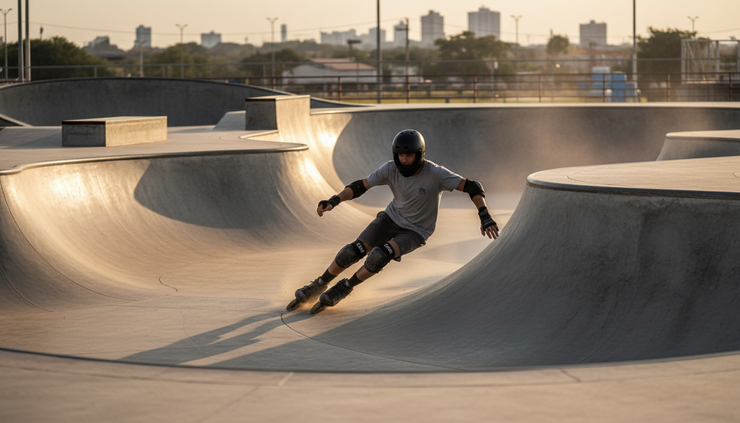
What makes Park especially interesting at a multi-sport event is its energy. Runs are quick, varied, and easy to follow. A fan can see line choice, speed, height, and risk in real time. The details may be technical, but the basic drama is open to everyone.
From October 13-18, Park will give athletes a final chance to show the full range of Roller Freestyle movement: speed, balance, creativity, and nerve.
Why Asunción is a fitting stage
The World Skate Games bring together different skating disciplines under one event structure, and Asunción gives the 2026 edition a distinct South American setting.
For Roller Freestyle, that setting matters. The sport has always carried a strong connection to public space, youth culture, and local scenes. Hosting these competitions in Paraguay places the sport in front of home-region fans while also drawing attention from the wider international skating community.
Major events can influence a scene long after the medals are awarded. Young skaters see new tricks up close. Local fans learn the difference between disciplines. Athletes meet peers from other countries. A city becomes part of the sport’s memory.
Asunción will not just host a schedule. It will provide the backdrop for runs, landings, celebrations, near-misses, and moments that may shape the next wave of interest in Roller Freestyle.
That is one of the strengths of the World Skate Games format. It does not isolate skating into one narrow category. It shows the breadth of wheel sports and gives each discipline a place in the larger story.
The schedule creates a natural build
The October schedule has a clear flow.
Street begins first, setting the tone with technical skating and creative obstacle use. Vert rises during the middle stretch, bringing height and aerial risk. Park arrives last, closing the Roller Freestyle program with speed, transition, and course-wide expression.
That order gives spectators a useful way to understand the discipline as a whole.
Street asks, how technical and original can the line be?
Vert asks, how high and controlled can the run stay?
Park asks, how well can the skater connect the whole course?
Seen together, the three events show why Roller Freestyle has such a broad appeal. It blends athletic skill with personal style. It rewards courage, but not recklessness. It values difficulty, but only when the skater can land it with control.
The dates also make planning easier for anyone following the Games:
October 4-8 Street sets the opening pace.
October 7-11 Vert overlaps the early program and raises the intensity.
October 13-18 Park delivers the final Roller Freestyle stretch.
Rather than one short burst of competition, the sport will have a continued presence across much of October.
What fans should watch for
Even without knowing every trick name, fans can follow Roller Freestyle by watching a few simple things.
First, watch speed. Skaters need enough of it to complete tricks, but too much can make landings harder to control. Managing speed is a skill on its own.
Next, watch landings. A clean landing keeps the run alive. A heavy landing, a hand down, or a balance correction can affect the flow.
Then watch variety. Repeating similar tricks can limit a run. Athletes who show different rotations, grinds, grabs, transfers, or obstacle choices usually make a stronger impression.
Finally, watch how the skater uses the space. This matters most in Street and Park, but it also applies to Vert. The best runs do not feel trapped in one idea. They use the course with purpose.

For newer fans, that is enough. Roller Freestyle is technical, but it is also visual. You can feel when a run has control. You can see when a trick carries risk. You can hear when the crowd knows a skater has landed something big.
A major October moment for Roller Freestyle
Roller Freestyle is ready for a major platform in Asunción, and the World Skate Games 2026 schedule gives it room to shine.
Street runs from October 4-8. Vert follows from October 7-11. Park closes the program from October 13-18. Together, those three stages show the sport from the ground to the sky and back through the curves of the park course.
The takeaway is clear: October 2026 will not offer just one version of Roller Freestyle. It will offer the full range, technical, aerial, fast, creative, and built for big moments in Asunción.


Comments